About Antonio Pinheiro

Antonio Pinheiro received the B.E. degree in electrical engineering from the I.S.T. University of Lisbon, Portugal, in 1988, and the Ph.D. degree in Electronic Systems Engineering from University of Essex in 2002. Since 1988 he is a lecture at University da Beira Interior (UBI), Portugal. His current research interests are on image processing and computer vision domains, including Multimedia Quality, Multimedia Privacy, and also on Image Classification and Medical Image Analysis. He is the Communication chair and a Portuguese committee member of ISO/IEC JTC 1/SC 29/WG 1 (JPEG). He has been Portuguese representative of the European COST Actions 292 and IC1003 -€“ Qualinet, and currently he is Portuguese representative of IC1206, DE-ID - De-identification for privacy protection in multimedia content and BM1304, MYO-MRI - Applications of MR imaging and spectroscopy techniques in neuromuscular disease.

JPEG Column: 79th JPEG Meeting in La Jolla, California, U.S.A.

The JPEG Committee had its 79th meeting in La Jolla, California, U.S.A., from 9 to 15 April 2018.

During this meeting, JPEG had a final celebration of the 25th anniversary of its first JPEG standard, usually known as JPEG-1. This celebration coincides with two interesting facts. The first was the approval of a reference software for JPEG-1, “only” after 25 years. At the time of approval of the first JPEG standard a reference software was not considered, as it is common in recent image standards. However, the JPEG committee decided that was still important to provide a reference software, as current applications and standards can largely benefit on this specification. The second coincidence was the launch of a call for proposals for a next generation image coding standard, JPEG XL. This standard will define a new representation format for Photographic information, that includes the current technological developments, and can become an alternative to the 25 years old JPEG standard.

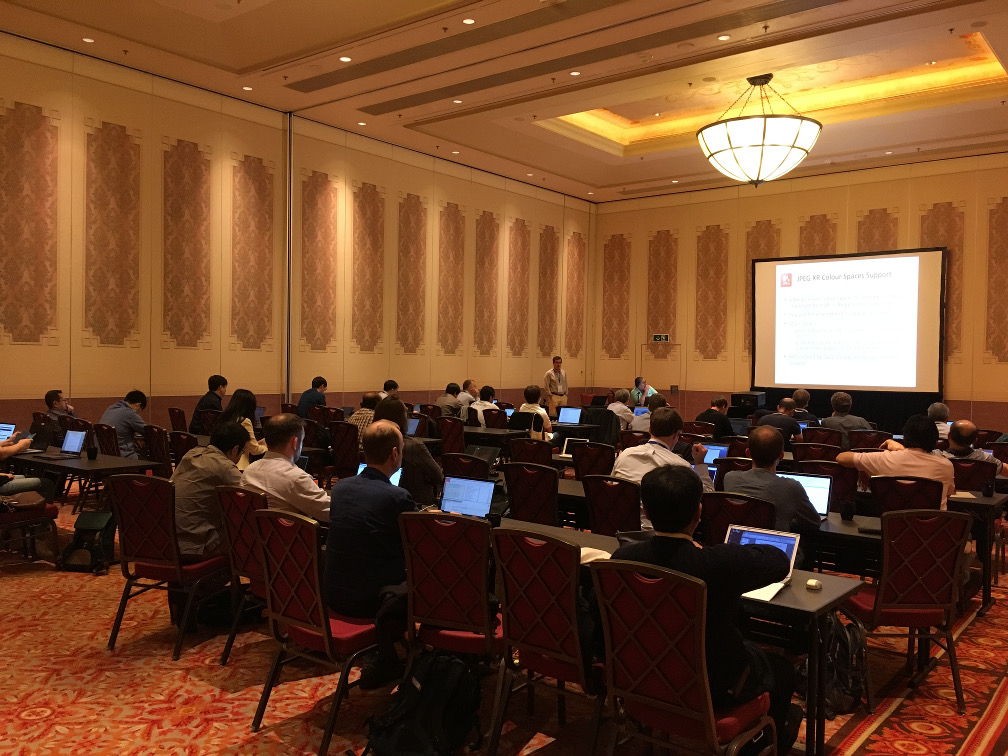
An informative two-hour JPEG Technologies Workshop marked the 25th anniversary celebration on Friday April 13, 2018. The workshop had presentations of several committee members on the current and future JPEG committee activity, with the following program:

IMG_4560

Touradj Ebrahimi, convenor of JPEG, presenting an overview of JPEG technologies.

  • Overview of JPEG activities, by Touradj Ebrahimi
  • JPEG XS by Antonin Descampe and Thomas Richter
  • HTJ2K by Pierre-Anthony Lemieux
  • JPEG Pleno – Light Field, Point Cloud, Holography by Ioan Tabus, Antonio Pinheiro, Peter Schelkens
  • JPEG Systems – Privacy and Security, 360 by Siegfried Foessel, Frederik Temmermans, Andy Kuzma
  • JPEG XL by Fernando Pereira, Jan De Cock

After the workshop, a social event was organized where a past JPEG committee Convenor, Eric Hamilton was recognized for key contributions to the JPEG standardization.

La Jolla JPEG meetings comprise mainly the following highlights:

  • Call for proposals of a next generation image coding standard, JPEG XL
  • JPEG XS profiles and levels definition
  • JPEG Systems defines a 360 degree format
  • HTJ2K
  • JPEG Pleno
  • JPEG XT
  • Approval of the JPEG Reference Software

The following summarizes various activities during JPEG’s La Jolla meeting.

JPEG XL

Billions of images are captured, stored and shared on a daily basis demonstrating the self-evident need for efficient image compression. Applications, websites and user interfaces are increasingly relying on images to share experiences, stories, visual information and appealing designs.

User interfaces can target devices with stringent constraints on network connection and/or power consumption in bandwidth constrained environments. Even though network capacities are improving globally, bandwidth is constrained to levels that inhibit application responsiveness in many situations. User interfaces that utilize images containing larger resolutions, higher dynamic ranges, wider color gamuts and higher bit depths, further contribute to larger volumes of data in higher bandwidth environments.

The JPEG Committee has launched a Next Generation Image Coding activity, referred to as JPEG XL. This activity aims to develop a standard for image coding that offers substantially better compression efficiency than existing image formats (e.g. more than 60% improvement when compared to the widely used legacy JPEG format), along with features desirable for web distribution and efficient compression of high-quality images.

To this end, the JPEG Committee has issued a Call for Proposals following its 79th meeting in April 2018, with the objective of seeking technologies that fulfill the objectives and scope of a Next Generation Image Coding. The Call for Proposals (CfP), with all related info, can be found at jpeg.org. The deadline for expression of interest and registration is August 15, 2018, and submissions to the Call are due September 1, 2018. To stay posted on the action plan for JPEG XL, please regularly consult our website at jpeg.org and/or subscribe to our e-mail reflector.


JPEG XS

This project aims at the standardization of a visually lossless low-latency lightweight compression scheme that can be used as a mezzanine codec for the broadcast industry, Pro-AV and other markets such as VR/AR/MR applications and autonomous cars. Among important use cases identified one can mention in particular video transport over professional video links (SDI, IP, Ethernet), real-time video storage, memory buffers, omnidirectional video capture and rendering, and sensor compression in the automotive industry. During the La Jolla meeting, profiles and levels have been defined to help implementers accurately size their design for their specific use cases. Transport of JPEG XS over IP networks or SDI infrastructures, are also being specified and will be finalized during the next JPEG meeting in Berlin (July 9-13, 2018). The JPEG committee therefore invites interested parties, in particular coding experts, codec providers, system integrators and potential users of the foreseen solutions, to contribute to the specification process. Publication of the core coding system as an International Standard is expected in Q4 2018.


JPEG Systems – JPEG 360

The JPEG Committee continues to make progress towards its goals to define a common framework and definitions for metadata which will improve the ability to share 360 images and provide the basis to enable new user interaction with images.  At the 79th JPEG meeting in La Jolla, the JPEG committee received responses to a call for proposals it issued for JPEG 360 metadata. As a result, JPEG Systems is readying a committee draft of “JPEG Universal Metadata Box Format (JUMBF)” as ISO/IEC 19566-5, and “JPEG 360” as ISO/IEC 19566-6.  The box structure defined by JUMBF allows JPEG 360 to define a flexible metadata schema and the ability to link JPEG code streams embedded in the file. It also allows keeping unstitched image elements for omnidirectional captures together with the main image and descriptive metadata in a single file.  Furthermore, JUMBF lays the groundwork for a uniform approach to integrate tools satisfying the emerging requirements for privacy and security metadata.

To stay posted on JPEG 360, please regularly consult our website at jpeg.org and/or subscribe to the JPEG 360 e-mail reflector. 


HTJ2K

High Throughput JPEG 2000 (HTJ2K) aims to develop an alternate block-coding algorithm that can be used in place of the existing block coding algorithm specified in ISO/IEC 15444-1 (JPEG 2000 Part 1). The objective is to significantly increase the throughput of JPEG 2000, at the expense of a small reduction in coding efficiency, while allowing mathematically lossless transcoding to and from codestreams using the existing block coding algorithm.

As a result of a Call for Proposals issued at its 76th meeting, the JPEG Committee has selected a block-coding algorithm as the basis for Part 15 of the JPEG 2000 suite of standards, known as High Throughput JPEG 2000 (HTJ2K). The algorithm has demonstrated an average tenfold increase in encoding and decoding throughput, compared to the algorithms based on JPEG 2000 Part 1. This increase in throughput results in less than 15% average loss in coding efficiency, and allows mathematically lossless transcoding to and from JPEG 2000 Part 1 codestreams.

A Working Draft of Part 15 to the JPEG 2000 suite of standards is now under development.


JPEG Pleno

The JPEG Committee is currently pursuing three activities in the framework of the JPEG Pleno Standardization: Light Field, Point Cloud and Holographic content coding.

JPEG Pleno Light Field finished a third round of core experiments for assessing the impact of individual coding modules and started work on creating software for a verification model. Moreover, additional test data has been studied and approved for use in future core experiments. Working Draft documents for JPEG Pleno specifications Part 1 and Part 2 were updated. A JPEG Pleno Light Field AhG was established with mandates to create a common test conditions document; perform exploration studies on new datasets, quality metrics, and random-access performance indicators; and to update the working draft documents for Part 1 and Part 2.

Furthermore, use cases were studied and are under consideration for JPEG Pleno Point Cloud. A current draft list is under discussion for the next period and will be updated and mapped to the JPEG Pleno requirements. A final document on use cases and requirements for JPEG Pleno Point Cloud is expected at the next meeting.

JPEG Pleno Holography has reviewed the draft of a holography overview document. Moreover, the current databases were classified according to use cases, and plans to analyze numerical reconstruction tools were established.


JPEG XT

The JPEG Committee released two corrigenda to JPEG XT Part 1 (core coding system) and JPEG XT Part 8 (lossless extension JPEG-1). These corrigenda clarify the upsampling procedure for chroma-subsampled images by adopting the centered upsampling in use by JFIF.


JPEG Reference Software

The JPEG Committee is pleased to announce that the CD ballot for Reference Software has been issued for the original JPEG-1 standard. This initiative closes a long-standing gap in the legacy JPEG standard by providing two reference implementations for this widely used and popular image coding format.

Final Quote

The JPEG Committee is hopeful to see its recently launched Next Generation Image Coding, JPEG XL, can result in a format that will become as important for imaging products and services as its predecessor was; the widely used and popular legacy JPEG format which has been in service for a quarter of century. said Prof. Touradj Ebrahimi, the Convenor of the JPEG Committee.

About JPEG

The Joint Photographic Experts Group (JPEG) is a Working Group of ISO/IEC, the International Organisation for Standardization / International Electrotechnical Commission, (ISO/IEC JTC 1/SC 29/WG 1) and of the International Telecommunication Union (ITU-T SG16), responsible for the popular JBIG, JPEG, JPEG 2000, JPEG XR, JPSearch and more recently, the JPEG XT, JPEG XS, JPEG Systems and JPEG Pleno families of imaging standards.

The JPEG Committee nominally meets four times a year, in different world locations. The 79th JPEG Meeting was held on 9-15 April 2018, in La Jolla, California, USA. The next 80th JPEG Meeting will be held on 7-13, July 2018, in Berlin, Germany.

More information about JPEG and its work is available at www.jpeg.org or by contacting Antonio Pinheiro or Frederik Temmermans (pr@jpeg.org) of the JPEG Communication Subgroup.

If you would like to stay posted on JPEG activities, please subscribe to the jpeg-news mailing list on http://jpeg-news-list.jpeg.org.  


Future JPEG meetings are planned as follows:JPEG-signature

  • No 80, Berlin, Germany, July 7 to13, 2018
  • No 81, Vancouver, Canada, October 13 to 19, 2018
  • No 82, Lisbon, Portugal, January 19 to 25, 2019

JPEG Column: 78th JPEG Meeting in Rio de Janeiro, Brazil

The JPEG Committee had its 78th meeting in Rio de Janeiro, Brazil. Relevant to its ongoing standardization efforts in JPEG Privacy and Security, JPEG organized a special session to explore how to support blockchain and distributed ledger technologies to past, ongoing and future JPEG family of standards. This is motivated by the fact that considering the potential impact of such technologies in the future of multimedia, standardization will be required to enable interoperability between different systems and services of imaging relying on blockchain and distributed ledger technologies.

Blockchain and distributed ledger technologies are behind the well-known crypto-currencies. These technologies can provide means for content authorship, or intellectual property and rights management control of the multimedia information. New possibilities can be made available, namely support for tracking online use of copyrighted images and ownership of the digital content.

IMG_3596_half

JPEG meeting session.

Rio de Janeiro JPEG meetings comprise mainly the following highlights:

  • JPEG explores blockchain and distributed ledger technologies
  • JPEG 360 Metadata
  • JPEG XL
  • JPEG XS
  • JPEG Pleno
  • JPEG Reference Software
  • JPEG 25th anniversary of the first JPEG standard

The following summarizes various activities during JPEG’s Rio de Janeiro meeting.

JPEG explores blockchain and distributed ledger technologies

During the 78th JPEG meeting in Rio de Janeiro, the JPEG committee organized a special session on blockchain and distributed ledger technologies and their impact on JPEG standards. As a result, the committee decided to explore use cases and standardization needs related to blockchain technology in a multimedia context. Use cases will be explored in relation to the recently launched JPEG Privacy and Security, as well as in the broader landscape of imaging and multimedia applications. To that end, the committee created an ad hoc group with the aim to gather input from experts to define these use cases and to explore eventual needs and advantages to support a standardization effort focused on imaging and multimedia applications. To get involved in the discussion, interested parties can register to the ad hoc group’s mailing list. Instructions to join the list are available on http://jpeg-blockchain-list.jpeg.org

JPEG 360 Metadata

The JPEG Committee notes the increasing use of multi-sensor images from multi-sensor devices, such as 360 degree capturing cameras or dual-camera smartphones available to consumers. Images from these cameras are shown on computers, smartphones, and Head Mounted Displays (HMDs). JPEG standards are commonly used for image compression and file format. However, because existing JPEG standards do not fully cover these new uses, incompatibilities have reduced the interoperability of their images, and thus reducing the widespread ubiquity, which consumers have come to expect when using JPEG files. Additionally, new modalities for interacting with images, such as computer-based augmentation, face-tagging, and object classification, require support for metadata that was not part of the original scope of JPEG.  A set of such JPEG 360 use cases is described in JPEG 360 Metadata Use Cases document. 

To avoid fragmentation in the market and to ensure wide interoperability, a standard way of interacting with multi-sensor images with richer metadata is desired in JPEG standards. JPEG invites all interested parties, including manufacturers, vendors and users of such devices to submit technology proposals for enabling interactions with multi-sensor images and metadata that fulfill the scope, objectives and requirements that are outlined in the final Call for Proposals, available on the JPEG website.

To stay posted on JPEG 360, please regularly consult our website at jpeg.org and/or subscribe to the JPEG 360 e-mail reflector.

JPEG XL

The Next-Generation Image Compression activity (JPEG XL) has produced a revised draft Call for Proposals, and intends to publish a final Call for Proposals (CfP) following its 79th meeting (April 2018), with the objective of seeking technologies that fulfill the objectives and scope of the Next-Generation Image Compression. During the 78th meeting, objective and subjective quality assessment methodologies for anchor and proposal evaluations were discussed and analyzed. As outcome of the meeting, source code for objective quality assessment has been made available.

The draft Call for Proposals, with all related info, can be found in JPEG website. Comments are welcome and should be submitted as specified in the document. To stay posted on the action plan for JPEG XL, please regularly consult our website at jpeg.org and/or subscribe to our e-mail reflector.


JPEG XS

Since its previous 77th meeting, subjective quality evaluations have shown that the initial quality requirement of the JPEG XS Core Coding System has been met, i.e. a visually lossless quality at a compression ratio of 6:1 for large majority of images under test has been met. Several profiles are now under development in JPEG XS, as well as transport and container formats. JPEG committee therefore invites interested parties – in particular coding experts, codec providers, system integrators and potential users of the foreseen solutions – to contribute to the furthering of the specifications in the above directions. Publication of the International Standard is expected for Q3 2018.

JPEG Pleno

JPEG Pleno activity is currently divided into Pleno Light Field, Pleno Point Cloud and Pleno Holography. JPEG Pleno Light Field has been preparing a third round of core experiments for assessing the impact of individual coding modules on the overall rate-distortion performance. Moreover, it was decided to pursue with collecting additional test data, and progress with the preparation of working documents for JPEG Pleno specifications Part 1 and Part 2.

Furthermore, quality modelling studies are under consideration for both JPEG Pleno Point Clouds, and JPEG Pleno Holography. In particular, JPEG Pleno Point Cloud is considering a set of new quality metrics provided as contributions to this work item. It is expected that the new metrics replace the current state of the art as they have shown superior correlation with subjective quality as perceived by humans. Moreover, new subjective assessment models have been tested and analysed to better understand the perception of quality for such new types of visual information.

JPEG Reference Software

The JPEG committee is pleased to announce that its first JPEG image coding specifications is now augmented by a new part, ISO/IEC 10918-7, that contains a reference software. The proposed candidate software implementations have been checked for compliance with 10918-2. Considering the positive results, this new part of the JPEG standard will continue to evolve quickly. 

RioJanView27332626_10155421780114370_2546088045026774482_n

JPEG meeting room window view during a break.

JPEG 25th anniversary of the first JPEG standard

JPEG’s first standard third and final 25th anniversary celebration is planned at its next 79th JPEG meeting taking place in La Jolla, CA, USA. The anniversary will be marked by a 2 hours workshop on Friday 13th April on current and emerging JPEG technologies, followed by a social event where past JPEG committee members with relevant contributions will be awarded.

Final Quote

“Blockchain and distributed ledger technologies promise a significant impact on the future of many fields. JPEG is committed to provide standard mechanisms to apply blockchain on multimedia applications in general and on imaging in particular. said Prof. Touradj Ebrahimi, the Convenor of the JPEG Committee.


About JPEG

The Joint Photographic Experts Group (JPEG) is a Working Group of ISO/IEC, the International Organisation for Standardization / International Electrotechnical Commission, (ISO/IEC JTC 1/SC 29/WG 1) and of the International Telecommunication Union (ITU-T SG16), responsible for the popular JBIG, JPEG, JPEG 2000, JPEG XR, JPSearch and more recently, the JPEG XT, JPEG XS, JPEG Systems and JPEG Pleno families of imaging standards.

The JPEG Committee meets nominally four times a year, in different world locations. The latest 77th meeting was held from 21st to 27th of October 2017, in Macau, China. The next 79th JPEG Meeting will be held on 9-15 April 2018, in La Jolla, California, USA.

More information about JPEG and its work is available at www.jpeg.org or by contacting Antonio Pinheiro or Frederik Temmermans (pr@jpeg.org) of the JPEG Communication Subgroup.

If you would like to stay posted on JPEG activities, please subscribe to the jpeg-news mailing list on http://jpeg-news-list.jpeg.org.  

Future JPEG meetings are planned as follows:

  • No 79, La Jolla (San Diego), CA, USA, April 9 to 15, 2018
  • No 80, Berlin, Germany, July 7 to13, 2018
  • No 81, Vancouver, Canada, October 13 to 19, 2018


JPEG Column: 77th JPEG Meeting in Macau, China

JPEG XS is now entering the final phases of the standard definition and soon will be available. It is important to clarify the change on the typical JPEG approach, as this is the first JPEG image compression standard that is not developed only targeting the best compression performance for the best perceptual quality. Instead, JPEG XS establishes a compromise between compression efficiency and low complexity. This new approach is also complemented with the development of a new part for the well-established JPEG 2000, named High Throughput JPEG 2000.

With these initiatives, JPEG committee is standardizing low complexity and low latency codecs, with a slight sacrifice of the compression performance usually seek in previous standards. This change of paradigm is justified considering the current trends on multimedia technology with the continuous grow on devices that are usually highly dependent of battery life cycles, namely mobiles, tablets, and also augmented reality devices or autonomous robots. Furthermore this standard provides support for applications like Omnidirectional video capture or real time video storage and streaming applications. Nowadays, networks tend to grow in available bandwidth. The memory available in most devices has also been reaching impressive numbers. Although compression is still required to simplify the large amount of data manipulation, its performance might become secondary if kept into acceptable levels. As it is obvious, considering the advances in coding technology of the last 25 years, these new approaches define codecs with compression performances largely above the JPEG standard used in most devices today. Moreover, they provide enhanced capabilities like HDR support, lossless or near lossless modes, or alpha plane coding.

On the 77th JPEG meeting held in Macau, China, from 21st to 27th of October several activities have been considered, as shortly described in the following.

IMG_3037r025

  1. A call for proposals on JPEG 360 Metadata for the current JPEG family of standards has been issued.
  2. New advances on low complexity/low latency compression standards, namely JPEG XS and High Throughput JPEG 2000.
  3. Continuation of JPEG Pleno project that will lead to a family of standards on different 3D technologies, like light fields, digital holography and also point clouds data.
  4. New CfP for the Next-Generation Image Compression Standard.
  5. Definition of a JPEG reference software.

Moreover, a celebration of the 25th JPEG anniversary where early JPEG committee members from Asia have been awarded has taken place.

The different activities are described in the following paragraphs.


JPEG Privacy and Security

JPEG Privacy & Security is a work item (ISO/IEC 19566-4) aiming at developing a standard that provides technical solutions, which can ensure privacy, maintaining data integrity and protecting intellectual property rights (IPR). A Call for Proposals was published in April 2017 and based on descriptive analysis of submitted solutions for supporting protection and authenticity features in JPEG files, a working draft of JPEG Privacy & Security in the context of JPEG Systems standardization was produced during the 77th JPEG meeting in Macau, China. To collect further comments from the stakeholders in this filed, an open online meeting for JPEG Privacy & Security will be conducted before the 78th JPEG meeting in Rio de Janeiro, Brazil, on Jan. 27-Feb 2, 2018. JPEG Committee invites interested parties to the meeting. Details will be announced in the JPEG Privacy & Security AhG email reflector.


JPEG 360 Metadata

The JPEG Committee has issued a “Draft Call for Proposals (CfP) on JPEG 360 Metadata” at the 77th JPEG meeting in Macau, China. The JPEG Committee notes the increasing use of multi-sensor images from multiple image sensor devices, such as 360 degree capturing cameras or dual-camera smartphones available to consumers. Images from these cameras are shown on computers, smartphones and Head Mounted Displays (HMDs). JPEG standards are commonly used for image compression and file format to store and share such content. However, because existing JPEG standards do not fully cover all new uses, incompatibilities have reduced the interoperability of 360 images, and thus reduce the widespread ubiquity, which consumers have come to expect when using JPEG-based images. Additionally, new modalities for interaction with images, such as computer-based augmentation, face-tagging, and object classification, require support for metadata that was not part of the scope of the original JPEG. To avoid fragmentation in the market and to ensure interoperability, a standard way of interaction with multi-sensor images with richer metadata is desired in JPEG standards. This CfP invites all interested parties, including manufacturers, vendors and users of such devices to submit technology proposals for enabling interactions with multi-sensor images and metadata that fulfill the scope, objectives and requirements.


High Throughput JPEG 2000

The JPEG Committee is continuing its work towards the creation of a new Part 15 to the JPEG 2000 suite of standards, known as High Throughput JPEG 2000 (HTJ2K).

Since the release of an initial Call for Proposals (CfP) at the outcome of its 76th meeting, the JPEG Committee has completed the software test bench that will be used to evaluate technology submissions, and has reviewed initial registrations of intent. Final technology submissions are due on 1 March 2018.

The HTJ2K activity aims to develop an alternate block-coding algorithm that can be used in place of the existing block coding algorithm specified in ISO/IEC 15444-1 (JPEG 2000 Part 1). The objective is to significantly increase the throughput of JPEG 2000, at the expense of a small reduction in coding efficiency, while allowing mathematically lossless transcoding to and from codestreams using the existing block coding algorithm.


JPEG XS

This project aims at the standardization of a visually lossless low-latency lightweight compression scheme that can be used as a mezzanine codec for the broadcast industry, Pro-AV and other markets. Targeted use cases are professional video links, IP transport, Ethernet transport, real-time video storage, video memory buffers, and omnidirectional video capture and rendering. After four rounds of Core Experiments, the Core Coding System has now been finalized and the ballot process has been initiated.

Additional parts of the Standard are still being specified, in particular future profiles, as well as transport and container formats. The JPEG Committee therefore invites interested parties – in particular coding experts, codec providers, system integrators and potential users of the foreseen solutions – to contribute to the further specification process. Publication of the International Standard is expected for Q3 2018.


JPEG Pleno

This standardization effort is targeting the generation of a multimodal framework for the exchange of light field, point cloud, depth+texture and holographic data in end-to-end application chains. Currently, the JPEG Committee is defining the coding framework of the light field modality for which the signalling syntax will be specified in part 2 of the JPEG Pleno standard. In parallel, JPEG is reaching out to companies and research institutes that are active in the point cloud and holography arena and invites them to contribute to the standardization effort. JPEG is seeking for additional input both at the level of test data and quality assessment methodologies for this specific type of image modalities as technology that supports their generation, reconstruction and/or rendering.


JPEG XL

The JPEG Committee has launched a Next-Generation Image Compression Standardization activity, also referred to as JPEG XL. This activity aims to develop a standard for image compression that offers substantially better compression efficiency than existing image formats (e.g. >60% over JPEG-1), along with features desirable for web distribution and efficient compression of high-quality images.

The JPEG Committee intends to issue a final Call for Proposals (CfP) following its 78th meeting (January 2018), with the objective of seeking technologies that fulfill the objectives and scope of the Next-Generation Image Compression Standardization activity.

A draft Call for Proposals, with all related info, has been issued and can be found in JPEG website. Comments are welcome and should be submitted as specified in the document.

To stay posted on the action plan for JPEG XL, please regularly consult our website at jpeg.org and/or subscribe to our e-mail reflector. You will receive information to confirm your subscription, and upon the acceptance of the moderator will be included in the mailing-list.


JPEG Reference Software

Along with its celebration of the 25th anniversary of the commonly known JPEG still image compression specifications, The JPEG Committee has launched an activity to fill a long-known gap in this important image coding standard, namely the definition of a JPEG reference software. For its 77th meeting, The JPEG Committee collected submissions for a reference software that were evaluated for suitability, and started now the standardization process of such software on the basis of submissions received.


IMG_1670r050

JPEG 25th anniversary of the first JPEG standard

The JPEG Committee had a 25th anniversary celebration of its first standard in Macau specifically organized to honour past committee members from Asia, and was proud to award Takao Omachi for his contributions to the first JPEG standard, Fumitaka Ono for his long lasting contributions to JBIG and JPEG standards, and Daniel Lee for contributions to JPEG family of standards and long lasting services as Convenor of the JPEG Committee. The celebrations of the anniversary of this successful standard that is still growing in its use after 25th years will have a third and final event during the 79th JPEG meeting planned in La Jolla, CA, USA.

JPEG77annivers25


Final Quote

“JPEG is committed to design of specifications that ensure privacy and other security and protection solutions across the entire JPEG family of standards” said Prof. Touradj Ebrahimi, the Convener of the JPEG committee. 


About JPEG

The Joint Photographic Experts Group (JPEG) is a Working Group of ISO/IEC, the International Organisation for Standardization / International Electrotechnical Commission, (ISO/IEC JTC 1/SC 29/WG 1) and of the International Telecommunication Union (ITU-T SG16), responsible for the popular JBIG, JPEG, JPEG 2000, JPEG XR, JPSearch and more recently, the JPEG XT, JPEG XS, JPEG Systems and JPEG Pleno families of imaging standards.

The JPEG group meets nominally three times a year, in Europe, North America and Asia. The latest 75th    meeting was held on March 26-31, 2017, in Sydney, Australia. The next (76th) JPEG Meeting will be held on July 15-21, 2017, in Torino, Italy.

More information about JPEG and its work is available at www.jpeg.org or by contacting Antonio Pinheiro and Frederik Temmermans of the JPEG Communication Subgroup at pr@jpeg.org.

If you would like to stay posted on JPEG activities, please subscribe to the jpeg-news mailing list on https://listserv.uni-stuttgart.de/mailman/listinfo/jpeg-news.  Moreover, you can follow JPEG twitter account on http://twitter.com/WG1JPEG

Future JPEG meetings are planned as follows:

  • No 78, Rio de Janeiro, Brazil, January 27 to February 2, 2018
  • No 79, La Jolla (San Diego), CA, USA, April 9 to 15, 2018
  • No 80, Berlin, Germany, July 7 to 13, 2018

JPEG Column: 76th JPEG Meeting in Turin, Italy

The 76th JPEG meeting was held at Politecnico di Torino, Turin, Italy, from 15 to 21 of July. The current standardisation activities have been complemented by the 25th anniversary of the first JPEG standard. Simultaneously, JPEG pursues the development of different standardised solutions to meet the current challenges on imaging technology, namely on emerging new applications and on low complexity image coding. The 76th JPEG meeting featured mainly the following highlights:

  • JPEG 25th anniversary of the first JPEG standard
  • High Throughput JPEG 2000
  • JPEG Pleno
  • JPEG XL
  • JPEG XS
  • JPEG Reference Software

In the following an overview of the main JPEG activities at the 76th meeting is given.

JPEG 25th anniversary of the first JPEG standard – JPEG is proud tocelebrate the 25th anniversary of its first standard. This very successful standard won an Emmy award in 1995-96 and its usage is still rising, reaching in 2015 the impressive daily rate of over 3 billion images exchanged in just a few social networks. During the celebration, a number of early members of the committee were awarded for their contributions to this standard, namely Alain Léger, Birger Niss, Jorgen Vaaben and István Sebestyén. Also Richard Clark for his long lasting contribution as JPEG Webmaster and contributions to many JPEG standards was also rewarded during the same ceremony. The celebration will continue at the next 77th JPEG meeting that will be held in Macau, China from 21 to 27, October, 2017.

IMG_1113 2

High Throughput JPEG 2000 – The JPEG committee is continuing its work towards the creation of a new Part 15 to the JPEG 2000 suite of standards, known as High Throughput JPEG 2000 (HTJ2K). In a significant milestone, the JPEG Committee has released a Call for Proposals that invites technical contributions to the HTJ2K activity. The deadline for an expression of interest is 1 October 2017, as detailed in the Call for Proposals, which is publicly available on the JPEG website at https://jpeg.org/jpeg2000/htj2k.html.

The objective of the HTJ2K activity is to identify and standardize an alternate block coding algorithm that can be used as a drop-in replacement for the block coding defined in JPEG 2000 Part-1. Based on existing evidence, it is believed that significant increases in encoding and decoding throughput are possible on modern software platforms, subject to small sacrifices in coding efficiency. An important focus of this activity is interoperability with existing systems and content libraries. To ensure this, the alternate block coding algorithm supports mathematically lossless transcoding between HTJ2K and JPEG 2000 Part-1 codestreams at the code-block level.

JPEG Pleno – The JPEG committee intends to provide a standard framework to facilitate capture, representation and exchange of omnidirectional, depth-enhanced, point cloud, light field, and holographic imaging modalities. JPEG Pleno aims at defining new tools for improved compression while providing advanced functionalities at the system level. Moreover, it targets to support data and metadata manipulation, editing, random access and interaction, protection of privacy and ownership rights as well as other security mechanisms. At the 76th JPEG meeting in Turin, Italy, responses to the call for proposals for JPEG Pleno light field image coding were evaluated using subjective and objective evaluation metrics, and a Generic JPEG Pleno Light Field Architecture was created. The JPEG committee defined three initial core experiments to be performed before the 77thJPEG meeting in Macau, China. Interested parties are invited to join these core experiments and JPEG Pleno standardization.

JPEG XL – The JPEG Committee is working on a new activity, known as Next generation Image Format, which aims to develop an image compression format that demonstrates higher compression efficiency at equivalent subjective quality of currently available formats and that supports features for both low-end and high-end use cases.  On the low end, the new format addresses image-rich user interfaces and web pages over bandwidth-constrained connections. On the high end, it targets efficient compression for high-quality images, including high bit depth, wide color gamut and high dynamic range imagery. A draft Call for Proposals (CfP) on JPEG XL has been issued for public comment, and is available on the JPEG website.

JPEG XS – This project aims at the standardization of a visually lossless low-latency lightweight compression scheme that can be used as a mezzanine codec for the broadcast industry and Pro-AV markets. Targeted use cases are professional video links, IP transport, Ethernet transport, real-time video storage, video memory buffers, and omnidirectional video capture and rendering. After a Call for Proposal and the assessment of the submitted technologies, a test model for the upcoming JPEG XS standard was created. Several rounds of Core Experiments have allowed to further improving the Core Coding System, the last one being reviewed during this 76th JPEG meeting in Torino. More core experiments are on their way, including subjective assessments. JPEG committee therefore invites interested parties – in particular coding experts, codec providers, system integrators and potential users of the foreseen solutions – to contribute to the further specification process. Publication of the International Standard is expected for Q3 2018.

JPEG Reference Software – Together with the celebration of 25th anniversary of the first JPEG Standard, the committee continued with its important activities around the omnipresent JPEG image format; while all newer JPEG standards define a reference software guiding users in interpreting and helping them in implementing a given standard, no such references exist for the most popular image format of the Internet age. The JPEG committee therefore issued a call for proposals https://jpeg.org/items/20170728_cfp_jpeg_reference_software.html asking interested parties to participate in the submission and selection of valuable and stable implementations of JPEG (formally, Rec. ITU-T T.81 | ISO/IEC 10918-1).


Final Quote

“The experience shared by developers of the first JPEG standard during celebration was an inspiring moment that will guide us to further the ongoing developments of standards responding to new challenges in imaging applications. said Prof. Touradj Ebrahimi, the Convener of the JPEG committee.

About JPEG

JPEG-signatureThe Joint Photographic Experts Group (JPEG) is a Working Group of ISO/IEC, the International Organisation for Standardization / International Electrotechnical Commission, (ISO/IEC JTC 1/SC 29/WG 1) and of the Interna
tional Telecommunication Union (ITU-T SG16), responsible for the popular JBIG, JPEG, JPEG 2000, JPEG XR, JPSearch and more recently, the JPEG XT, JPEG XS, JPEG Systems and JPEG Pleno families of imaging standards.

The JPEG group meets nominally three times a year, in Europe, North America and Asia. The latest 75th    meeting was held on March 26-31, 2017, in Sydney, Australia. The next (76th) JPEG Meeting will be held on July 15-21, 2017, in Torino, Italy.

More information about JPEG and its work is available at www.jpeg.org or by contacting Antonio Pinheiro and Frederik Temmermans of the JPEG Communication Subgroup at pr@jpeg.org.

If you would like to stay posted on JPEG activities, please subscribe to the jpeg-news mailing list on https://listserv.uni-stuttgart.de/mailman/listinfo/jpeg-news.  Moreover, you can follow JPEG twitter account on http://twitter.com/WG1JPEG.

Future JPEG meetings are planned as follows:

  • No. 77, Macau, CN, 23 – 27 October 2017


JPEG Column: 75th JPEG Meeting in Sydney, Australia

The 75th JPEG meeting was held at National Standards Australia in Sydney, Australia, from 26 to 31 March. Multiples activities have been ensued, pursuing the development of new standards that meet the current requirements and challenges on imaging technology. JPEG is continuously trying to provide new reliable solutions for different image applications. The 75th JPEG meeting featured mainly the following highlights:

  • JPEG issues a Call for Proposals on Privacy & Security;Image may contain: 3 people, people sitting, screen and indoor
  • New draft Call for Proposal for a Part 15 of JPEG 2000 standard on High Throughput coding;
  • JPEG Pleno defines methodologies for proposals evaluation;
  • A test model for the upcoming JPEG XS standard was created;
  • A new standardisation effort on Next generation Image Formats was initiated.

In the following an overview of the main JPEG activities at the 75th meeting is given.

JPEG Privacy & Security – JPEG Privacy & Security is a work item (ISO/IEC 19566-4) aiming at developing a standard for providing technical solutions which can ensure privacy, maintaining data integrity, and protecting intellectual property rights (IPR). JPEG Privacy & Security is exploring ways on how to design and implement the necessary features without significantly impacting coding performance while ensuring scalability, interoperability, and forward & backward compatibility with current JPEG standard frameworks.
Since the JPEG committee intends to interact closely with actors in this domain, public workshops on JPEG Privacy & Security were organised in previous JPEG meetings. The first workshop was organized on October 13, 2015 during the JPEG meeting in Brussels, Belgium. The second workshop was organized on February 23, 2016 during the JPEG meeting in La Jolla, CA, USA. Following the great success of these workshops, a third and final workshop was organized on October 18, 2016 during the JPEG meeting in Chengdu, China. These workshops targeted on understanding industry, user, and policy needs in terms of technology and supported functionalities. The proceedings of these workshops are published on the Privacy and Security page of JPEG website at www.jpeg.org under Systems section.
The JPEG Committee released a Call for Proposals that invites contributions on adding new capabilities for protection and authenticity features for the JPEG family of standards. Interested parties and content providers are encouraged to participate in this standardization activity and submit proposals. The deadline for an expression of interest and submissions of proposals has been set to October 6th, 2017, as detailed in the Call for Proposals. The Call for Proposals on JPEG Privacy & Security is publicly available on the JPEG website, https://jpeg.org/jpegsystems/privacy_security.html.

High Throughput JPEG 2000 – The JPEG committee is working towards the creation of a new Part 15 to the JPEG 2000 suite of standards, known as High Throughput JPEG 2000 (HTJ2K). The goal of this project is to identify and standardize an alternate block coding algorithm that can be used as a drop-in replacement for the algorithm defined in JPEG 2000 Part-1. Based on existing evidence, it is believed that large increases in encoding and decoding throughput (e.g., 10X or beyond) should be possible on modern software platforms, subject to small sacrifices in coding efficiency. An important focus of this activity is inter-operability with existing systems and content repositories. In order to ensure this, the alternate block coding algorithm that will be the subject of this new Part of the standard should support mathematically lossless transcoding between HTJ2K and JPEG 2000 Part-1 codestreams at the code-block level. A draft Call for Proposals (CfP) on HTJ2K has been issued for public comment, and is available on JPEG web-site.

JPEG Pleno – The responses to the JPEG Pleno Call for Proposals on Light Field Coding will be evaluated at the July JPEG meeting in Torino. During JPEG 75th meetings has been defined the quality assessment procedure for this highly challenging type of large volume data. In addition to light fields, JPEG Pleno is also addressing point cloud and holographic data. Currently, the committee is undertaking in-depth studies to prepare standardization efforts on coding technologies for these image data types, encompassing the collection of use cases and requirements, but also investigations towards accurate and appropriate quality assessment procedures for associated representation and coding technologies. JPEG committee is probing for input from the involved industrial and academic communities.

JPEG XS – This project aims at the standardization of a visually lossless low-latency lightweight compression scheme that can be used as a mezzanine codec for the broadcast industry and Pro-AV markets. Targeted use cases are professional video links, IP transport, Ethernet transport, real-time video storage, video memory buffers, and omnidirectional video capture and rendering. After a Call for Proposal and the assessment of the submitted technologies, a test model for the upcoming JPEG XS standard was created and results of core experiments have been reviewed during the 75th JPEG meeting in Sydney. More core experiments are on their way to further improve the final standard: JPEG committee therefore invites interested parties – in particular coding experts, codec providers, system integrators and potential users of the foreseen solutions – to contribute to the further specification process.

Next generation Image Formats – The JPEG Committee is exploring a new activity, which aims to develop an image compression format that demonstrates higher compression efficiency at equivalent subjective quality of currently available formats, and that supports features for both low-end and high-end use cases.  On the low end, the new format addresses image-rich user interfaces and web pages over bandwidth-constrained connections. On the high end, it targets efficient compression for high-quality images, including high bit depth, wide color gamut and high dynamic range imagery.

Final Quote

“JPEG is committed to accommodate reliable and flexible security tools for JPEG file formats without compromising legacy usage of our standards said Prof. Touradj Ebrahimi, the Convener of the JPEG committee.

About JPEG

JPEG-signatureThe Joint Photographic Experts Group (JPEG) is a Working Group of ISO/IEC, the International Organisation for Standardization / International Electrotechnical Commission, (ISO/IEC JTC 1/SC 29/WG 1) and of the Interna
tional Telecommunication Union (ITU-T SG16), responsible for the popular JBIG, JPEG, JPEG 2000, JPEG XR, JPSearch and more recently, the JPEG XT, JPEG XS, JPEG Systems and JPEG Pleno families of imaging standards.

The JPEG group meets nominally three times a year, in Europe, North America and Asia. The latest 75th    meeting was held on March 26-31, 2017, in Sydney, Australia. The next (76th) JPEG Meeting will be held on July 15-21, 2017, in Torino, Italy.

More information about JPEG and its work is available at www.jpeg.org or by contacting Antonio Pinheiro (pinheiro@ubi.pt) or Frederik Temmermans (ftemmerm@etrovub.be) of the JPEG Communication Subgroup.

If you would like to stay posted on JPEG activities, please subscribe to the jpeg-news mailing list on https://listserv.uni-stuttgart.de/mailman/listinfo/jpeg-news.  Moreover, you can follow JPEG twitter account on http://twitter.com/WG1JPEG.

Future JPEG meetings are planned as follows:

  • No. 76, Torino, IT, 17 – 21 July, 2017
  • No. 77, Macau, CN, 23 – 27 October 2017

JPEG Column: 74th JPEG Meeting

The 74th JPEG meeting was held at ITU Headquarters in Geneva, Switzerland, from 15 to 20 January featuring the following highlights:

  • A Final Call for Proposals on JPEG Pleno was issued focusing on light field coding;
  • Creation of a test model for the upcoming JPEG XS standard;
  • A draft Call for Proposals for JPEG Privacy & Security was issued;
  • JPEG AIC technical report finalized on Guidelines for image coding system evaluation;
  • An AHG was created to investigate the evidence of high throughput JPEG 2000;
  • An AHG on next generation image compression standard was initiated to explore a future image coding format with superior compression efficiency.


JPEG Pleno kicks off its activities towards JPEGmeeting74standardization of light field coding

At the 74th JPEG meeting in Geneva, Switzerland the final Call for Proposals (CfP) on JPEG Pleno was issued particularly focusing on light field coding. The CfP is available here.

The call encompasses coding technologies for lenslet light field cameras, and content produced by high-density arrays of cameras. In addition, system-level solutions associated with light field coding and processing technologies that have a normative impact are called for. In a later stage, calls for other modalities such as point cloud, holographic and omnidirectional data will be issued, encompassing image representations and new and rich forms of visual data beyond the traditional planar image representations.

JPEG Pleno intends to provide a standard framework to facilitate capture, representation and exchange of these omnidirectional, depth-enhanced, point cloud, light field, and holographic imaging modalities. It aims to define new tools for improved compression while providing advanced functionalities at the system level. Moreover, it targets to support data and metadata manipulation, editing, random access and interaction, protection of privacy and ownership rights as well as other security mechanisms.


JPEG XS aims at the standardization of a visually lossless low-latency lightweight compression scheme that can be used for a wide range of applications including mezzanine codec for the broadcast industry and Pro-AV markets. Targeted use cases are professional video links, IP transport, Ethernet transport, real-time video storage, video memory buffers, and omnidirectional video capture and rendering. After a Call for Proposal issued on March 11th 2016 and the assessment of the submitted technologies, a test model for the upcoming JPEG XS standard was created during the 73rd JPEG meeting in Chengdu and the results of a first set of core experiments have been reviewed during the 74th JPEG meeting in Geneva. More core experiments are on their way before finalizing the standard: JPEG committee therefore invites interested parties – in particular coding experts, codec providers, system integrators and potential users of the foreseen solutions – to contribute to the further specification process.


JPEG Privacy & Security aims at developing a standard for realizing secure image information sharing which is capable of ensuring privacy, maintaining data integrity, and protecting intellectual property rights (IPR). JPEG Privacy & Security will explore ways on how to design and implement the necessary features without significantly impacting coding performance while ensuring scalability, interoperability, and forward and backward compatibility with current JPEG standard frameworks.

A draft Call for Proposals for JPEG Privacy & Security has been issued and the JPEG committee invites interested parties to contribute to this standardisation activity in JPEG Systems. The draft of CfP is available here.

The call addresses protection mechanisms and technologies such as handling hierarchical levels of access and multiple protection levels for metadata and image protection, checking integrity of image data and embedded metadata, and supporting backward and forward compatibility with JPEG coding technologies. Interested parties are encouraged to subscribe to the JPEG Privacy & Security email reflector for collecting more information. A final version of the JPEG Privacy & Security Call for Proposals is expected at the 75th JPEG meeting located in Sydney, Australia.


JPEG AIC provides guidance and standard procedures for advanced image coding evaluation.  At this meeting JPEG completed a technical report: TR 29170-1 Guidelines for image coding system evaluation. This report is a compendium of JPEGs best practices in evaluation that draws sources from several different international standards and international recommendations. The report discusses use of objective tools, subjective procedures and computational analysis techniques and when to use the different tools. Some of the techniques are tried and true tools familiar to image compression experts and vision scientists. Several tools represent new fields where few tools have been available, such as the evaluation of coding systems for high dynamic range content.


High throughput JPEG 2000

The JPEG committee started a new activity for high throughput JPEG 2000 and an AHG was created to investigate the evidence for such kind of standard. Experts are invited to participate in this expert group and to join the mailing list.


Final Quote

“JPEG continues to offer standards that redefine imaging products and services contributing to a better society without borders.” said Prof. Touradj Ebrahimi, the Convener of the JPEG committee.


About JPEG

The Joint Photographic Experts Group (JPEG) is a Working Group JPEG-signatureof ISO/IEC, the International Organisation for Standardization / International Electrotechnical Commission, (ISO/IEC JTC 1/SC 29/WG 1) and of the International Telecommunication Union (ITU-T SG16), responsible for the popular JBIG, JPEG, JPEG 2000, JPEG XR, JPSearch and more recently, the JPEG XT, JPEG XS and JPEG Systems and JPEG PLENO families of imaging standards.

More information about JPEG and its work is available at www.jpeg.org or by contacting Antonio Pinheiro and Tim Bruylants of the JPEG Communication Subgroup at pr@jpeg.org.

If you would like to stay posted on JPEG activities, please subscribe to the jpeg-news mailing list on https://listserv.uni-stuttgart.de/mailman/listinfo/jpeg-news.   Moreover, you can follow JPEG twitter account on http://twitter.com/WG1JPEG.


Future JPEG meetings are planned as follows:

  • No. 75, Sydney, AU, 26 – 31 March, 2017
  • No. 76, Torino, IT, 17 – 21 July, 2017
  • No. 77, Macau, CN, 23 – 27 October 2017