The International Conference on Similarity Search and Applications (SISAP) is an annual forum for researchers and application developers in the area of similarity data management. It aims at the technological problems shared by numerous application domains, such as data mining, information retrieval, multimedia, computer vision, pattern recognition, computational biology, geography, biometrics, machine learning, and many others that make use of similarity search as a necessary supporting service.
From its roots as a regional workshop in metric indexing, SISAP has expanded to become the only international conference entirely devoted to the issues surrounding the theory, design, analysis, practice, and application of content-based and feature-based similarity search. The SISAP initiative has also created a repository serving the similarity search community, for the exchange of examples of real-world applications, the source code for similarity indexes, and experimental testbeds and benchmark data sets (http://www.sisap.org). The proceedings of SISAP are published by Springer as a volume in the Lecture Notes in Computer Science (LNCS) series.
The 2019 edition of SISAP was held at the New Jersey Institute of Technology in Newark, New Jersey, USA. Newark is an attractive location in the New York City metropolitan area with easy and convenient travel to and from the conference. The organization was smooth and with a strong technical program assembled by two co-chairs and sixty program committee members. Each paper was reviewed by at least three referees. SISAP 2019 received 42 papers and accepted 12 as full papers (28% acceptance rate). The program was completed with three keynote speakers of high calibre and one panel.
The first keynote speaker was Fabrizio Silvestri, a Software Engineer at Facebook London working in the Search Systems team. The Facebook AI team in London deals with applying artificial intelligence techniques to address societal problems such as the spread of online misinformation, or the integrity of election processes around the world. To do so, the team has developed a set of tools that exploit similarity search technologies to efficiently and effectively run a very high number of classification tasks on a massive set of data. Fabrizio Silvestri’s talk reviewed some of the problems studied and the solutions adopted.
The second keynote speaker was Alexander Tuzhilin, the Leonard N. Stern Professor of Business in the Department of Technology, Operations and Statistics at the Stern School of Business, NYU. Alex Tuzhilin discussed the role of similarity measures in recommender systems. Measures of similarity between users and between items to be recommended to the users lie at the core of many recommendation algorithms, and numerous metrics have been proposed in the recommender systems field since its inception. The talk explored the evolution of various similarity-based measures from the initial class of rating-based measures to the more recently proposed latent metrics and the metric learning methods. It also explored possible future research directions and novel applications of similarity measures in recommender systems.
The third keynote speaker was Dr. Cong Yu, a research scientist and manager at Google Research in New York City. Cong Yu leads the Structured Data Research Group. The group’s mission is to understand and leverage structured data on the Web to enhance user experience for Google products and has been responsible for several impactful products such as WebTables, Structured Snippets, and Fact-Checking at Google. Currently, his group focuses on technical research for news and has been partnering with journalists and policy advisors to combat online misinformation and improve news consumption. The ClaimReview structured data (http://schema.org/ClaimReview) is a successful example of such collaborations and powers various fact check features for Google. This talk described the genesis of ClaimReview and its role in combating online misinformation.
The SISAP 2019 panel was on Deep Learning meets Similarity Search. The panel was moderated by K. Selçuk Candan (Arizona State University, USA). The panellists were James Bailey (University of Melbourne, Australia), Ilaria Bartolini (University of Bologna, Italy), Michael Houle (National Institute of Informatics, Japan) and Stéphane Marchand-Maillet (University of Geneva, Switzerland).
As it is usually the case, SISAP 2019 included a program with papers exploring various similarity-aware data analysis and processing problems from multiple perspectives. The papers presented at the conference in 2019 studied the role of similarity processing in the context of metric search, visual search, nearest neighbour queries, clustering, outlier detection, and graph analysis. Some of the papers had a theoretical emphasis, while others had a systems perspective, presenting experimental evaluations comparing against state-of-the-art methods. An interesting event at the 2019 conference, as well as the two previous editions, was an electronic poster session that included all accepted papers. This component of the conference generated many lively interactions between presenters and attendees, to not only learn more about the presented techniques but also to identify potential topics for future collaboration.
In a tradition that began with the 2009 conference in Prague, extended versions of the top-ranked papers were invited for a Special Issue of the Information Systems journal. A shortlist for the best papers was created from those conference papers nominated by at least one of their 3 reviewers. An award committee of 3 researchers ranked the shortlisted papers, from which a final ranking was decided. The Best Paper Award was presented to Martin Aumüller and Matteo Ceccarello (IT University of Copenhagen, Copenhagen, Denmark) for the paper titled “The Role of Local Intrinsic Dimensionality in Benchmarking Nearest Neighbor Search” during the Conference Dinner. The best paper reconsiders common benchmarking approaches to nearest neighbour search and studies the effect of different local intrinsic dimensionality (LID) distributions on the running time performance of different implementations.
In addition to the excellent conference facilities at NJIT, we had several student volunteers who were ready to help ensure that the logistical aspects of the conference ran smoothly. Our conference banquet was held at the Newark Museum (https://www.newarkmuseum.org), the largest museum of the state of New Jersey. It holds major collections of American art, decorative arts, contemporary art, and arts of Asia, Africa, the Americas, and the ancient world. The participants were given a highlight tour of the museum prior to the banquet held in the Ballantine House. The Ballantine House is part of The Newark Museum since 1937, the house was designed a National Historic Landmark in 1985. Built in 1885 for Jeannette and John Holme Ballantine, of the celebrated Newark beer-brewing family, this brick and limestone mansion originally had 27 rooms, including eight bedrooms and three bathrooms.
SISAP 2019 demonstrated that the SISAP community has a strong stable kernel of researchers, active in the field of similarity search and to fostering the growth of the community. Organizing SISAP is a smooth experience thanks to the support of the Steering Committee and dedicated participants.
The SISAP 2019 Doctoral Symposium provided a forum for PhD students to present their research ideas and receive feedback from senior members of the research community. The Symposium fostered a collaborative environment with constructive discussions that benefited the students.
SISAP 2020 was supposed to be organized in Copenhagen by Martin Aumüller, Björn Þór Jónsson and Rasmus Pagh from the IT University of Copenhagen. But it will become a virtual event because of the COVID-19 pandemic. One of the major challenges of the SISAP conference series is to continue to raise its profile in the landscape of scientific events related to information indexing, database and search systems.
Conor Keighrey (@ConorKeighrey) recently completed his PhD in the Athlone Institute of Technology which aimed to capture and understand the quality of experience (QoE) within a novel immersive multimedia speech and language assessment. He is currently interested in exploring the application of immersive multimedia technologies within health, education and training.
With a warm welcome from Istanbul, Ali C. Begen (Ozyegin University and Networked Media, Turkey) opened MMSys 2020 this year. In light of the global pandemic, the conference has taken a new format being delivered online for the first time. This, however, was not the only first for MMSys, Laura Toni (University College London, UK) is introduced as the first-ever female co-chair for the conference. This year, the organising committee presented gender and culturally diverse line-up of researchers from all around the globe. In parallel, two new grand challenges were introduced on the topics of “Improving Open-Source HEVC Encoding” and “Low-latency live streaming” for the first time ever at MMSys.
The conference attracted paper submissions from a range of multimedia topics including but not limited to streaming technologies, networking, machine learning, volumetric media, and fake media detection tools. Core areas were complemented with in-depth keynotes delivered by academic and industry experts.
Examples of such include Ryan Overbeck’s (Google, USA) keynote on “Light Fields – Building the Core Immersive Photo and Video Format for VR and AR” presented on the first day. Light fields provide the opportunity to capture full 6DOF and photo-realism in virtual reality. In his talk, Ryan provided key insight into the camera rigs and results from Google’s recent approach to perfect the capture of virtual representations of real-world spaces.
Later during the conference, Roderick Hodgson from Amber Video presented an interesting keynote on “Preserving Video Truth: an Anti-Deepfakes Narrative”. Roderick delivered a fantastic overview of the emerging area of deep fakes, and the application platforms which are being developed to detect, what will without a doubt be used as highly influential media streams in the future. Discussion closed with Stefano Petrangeli asking how the concept of deep fakes could be applied within the context of AR filters. Although AR is within its infancy from a visual quality perspective, the future may rapidly change how we perceive faces through immersive multimedia experiences utilizing AR filters. The concept is interesting, and it leads to the question of what future challenges will be seen with these emerging technologies.
Although not the main focus of the MMSys conference, the co-located workshops have always stood out for me. I have attended MMSys for the last three years and the warm welcome expressed by all members of the research community has been fantastic. However, the workshops have always shined through as they provide the opportunity to meet those who are working in focused areas of multimedia research. This year’s MMSys was no different as it hosted three workshops:
NOSSDAV – The International workshop on Network and Operating System Support for Digital Audio and Video
MMVE – The International Workshop on Immersive Mixed and Virtual Environment Systems
With a focus on novel immersive media experiences, the MMVE workshop was highly successful with five key presentations exploring the topics of game mechanics, cloud computing, head-mounted display field of view prediction, navigation, and delay. Highlights include the work presented by Na Wang et. Al (George Mason University) which explored field of view prediction within augmented reality experiences on mobile platforms. With the emergence of new and proposed areas of research in augmented reality cloud, field of view predication will alleviate some of the challenges associated with the optimization of network communication for novel immersive multimedia experiences in the future.
Unlike previous years, conference organisers faced the challenge of creating social events which were completely online. A trivia night hosted on Zoom brought over 40 members of the MMSys community together virtually to test their knowledge against a wide array of general knowledge. Utilizing online the platform “Kahoot”, attendees were challenged with a series of 47 questions. With great interaction from the audience, the event provided a great opportunity to socialise in a relaxing manner much like the real world counterpart!
Leader boards towards the end were close, with Wei Tsang Ooi gaining the first place with a last-minute bonus question! Jean Botev and Roderick Hodgson took second and third place respectively. Events like this have always been a highlight of the MMSys community, we hope to see it take place this coming year in person over some quite beers and snacks!
Mea Wang opened the N2Women Meeting on the 10th of June. The event openly discussed core influential topics such as the separation of work and life needs within the research community. With a primary objective of assisting new researchers to maintain a healthy work and life balance. Overall, the event was a success, the topic of work and life balance is important for those at all stages of their research careers. Reflecting on my own personal experiences during my PhD, it can be a struggle to determine when to “clock out” and when to spend a few extra hours engaged with research. Key members of the community shared their own personal experiences, discussing other topics such the importance of mentoring, as academic supervisors can often become a mentor for life. Ozgu Alay discussed the importance of developing connections at research-orientated events. Those new to the community should not be afraid to spark a conversation with experts in the field, often the ideal approach is to take interest in their work and begin discussion from there.
Lastly, Mea Wang mentioned that the initiative had initially acquired funding for the purpose of travel supports and childcare for those attending the conference. Due to the online nature this year, the supports have now been placed aside for next year’s event. Such funding provides a fantastic opportunity to support the cost of attending an international conference and engage with the multimedia community!
Closing the conference, Ali C. Begen opened with the announcement of the awards. The Best Paper Award was presented by Özgü Alay and Christian Timmerer who announced Nan Jiang et al as the winner for their paper on “QuRate: Power-Efficient Mobile Immersive Video Streaming”. The paper is available for download on the ACM Digital Library at the following link. The conference closed with the announcement of key celebrations for next year as the NOSSDAV workshop celebrates it’s 30thanniversary, and the Packet Video workshop celebrates the 25th anniversary!
Overall, the expertise in multimedia shined through in this year’s ACM MMSys, with fantastic keynotes, presentations, and demonstrations from researchers around the globe. Although there are many benefits to attending a virtual conference, after numerous experiences this year I can’t help but feel there is something missing. Over the past 3 years, I’ve attended ACM MMSys in person as a PhD candidate, one of the major benefits of in person events are social encounters. Although this year’s iteration of ACM MMSys did a phenomenal job at the presentation of these events in the new and unexpected virtual format. I believe that it is these social events which shine through as they provide the opportunity to meet, discuss, and develop professional and social links throughout the multimedia research community in a more relaxed setting.
As a result, I look forward to what Özgü Alay, Cheng-Hsin Hsu, and Ali C. Begen have in store for us at ACM Multimedia Systems 2021, located in the beautiful city of Istanbul, Turkey.
I work in the department of Research & Development, based in London, at the BBC. My interests include Interactive and Immersive Media, Interaction Design, Evaluative Methods, Virtual Reality, Augmented Reality, Synchronised Experiences & Connected Homes. In the interest of full disclosure, I serve on the steering board of ACM Interactive Media Experiences (IMX) as Vice President for Conferences. It was an honour to be invited to the organising committee as one of IMX’s first Diversity Co-Chairs and as a Doctoral Consortium Co-Chair. I will also be the General Co-Chair for ACM IMX 2021. I hope you join us at IMX 2021 but if you need convincing, please read on about my experiences with IMX 2020! I am quite active on Twitter (@What2DoNext), so I don’t think it came as a massive surprise to the IMX community that I won the award of the Best Social Media Reporter for ACM IMX 2020. Here are some of the award-winning tweets describing a workshop, a creative challenge, the opening keynote, my co-author presenting our paper (which incidentally won an honourable mention), the closing keynote and announcing the venue for ACM IMX 2021. This report is a summary of my experiences with IMX 2020.
Before the conference
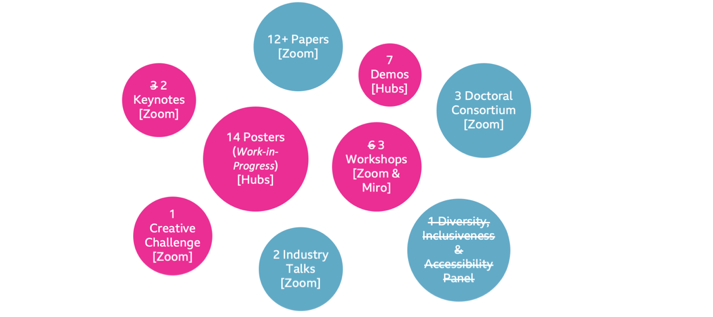
Summary of activities at IMX 2020.
For the first time in the history of IMX, it was going entirely virtual. As if that wasn’t enough, IMX 2020 was the conference that got rebranded. In 2019, it was called TVX – Interactive Experiences for Television and Online Video! However, the steering committee unanimously voted to rename and rebrand it to reflect the fact that the conference had outgrown its original remit. The new name – Interactive Media Experiences (IMX) – was succinct and all-compassing of the conference’s current scope. With the rebrand, came a revival of principles and ethos. For the first time in the history of IMX, the organising committee worked with the steering committee to include Diversity co-chairs.
The tech industry has suffered from a lack of diverse representation, and 2020 was the year, we decided to try to improve the situation in the IMX community. So, in addition to holding the position of the Doctoral Consortium co-chair, a relatively well-defined role, I was invited to be one of two Diversity chairs. The conference was going to take place in Barcelona, Spain – a city I have been lucky to visit multiple times. I love the people, the culture, the food (and wine) and the city, especially in the summer. The organisation was on track when, due to the unprecedented and global pandemic, we called in an emergency meeting to immediately transfer conference activities to various online platforms. Unfortunately, we lost one keynote, a panel, & 3 workshops, but we managed to transfer the rest into a live virtual event over a combination of platforms: Zoom, Mozilla Hubs, Miro, Slack & Sli.do.
The organising committee came together to reach out to the IMX community to ask for their help in converting their paper, poster and demo presentations to a format suitable for a virtual conference. We were quite amazed at how the community came together to make the virtual conference possible. Quite a few of us spent a lot of late nights getting everything ready!
We set about creating an accessible program and proceedings with links to the various online spaces scheduled to host track sessions and links to papers for better access using the SIGCHI progressive web app and the ACM Publishing System. It didn’t hurt that one of our Technical Program chairs, David A. Shamma, is the current SIGCHI VP of Operations. It was also helpful to have access to the ACM’s guide for virtual conferences and the experience gained by folks like Blair McIntyre (general co-chair of IEEE VR 2020 & Professor at Georgia Institute of Technology). We also got lots of support from Liv Erickson (Emerging Tech Product Manager at Mozilla).
About a week before the conference, Mario Montagud (General Co-Chair) sent an email to all registered attendees to inform them about how to join. Honestly, there were moments when I thought it might be touch and go. I had issues with my network, last-minute committee jobs kept popping up, and social distancing was becoming problematic.
During the conference…
Traditionally, IMX brings together international researchers and practitioners from a wide range of disciplines to attend workshops and challenges on the first day followed by two days of keynotes, panels, paper presentations, posters and demos. The activities are interspersed with lunches, networking with colleagues, copious coffee and a social event.
The advantage of a virtual event is that I had no jet lag and I woke up in my bed at home on the day of the conference. However, I had to provide my coffee and lunches in the 2020 instantiation while (very briefly) considering the option of attending an international conference in my pyjamas. The other early difference is that I didn’t get a name badge in a conference branded registration packet, however, due to my committee roles at IMX 2020, the communications team made us zoom background ‘badges’ – which I loved!
Virtual Backgrounds for use in Zoom.
My first day was exciting and diverse! I had a three-hour workshop in the morning (starting 10 AM BST) titled “Toys & the TV: Serious Play” I had organised with my colleagues Suzanne Clark and Barbara Zambrini from BBC R&D, Christoph Ziegler from IRT and Rainer Kirchknopf from ZDF. We had a healthy interest in the workshop and enthusiastic contributions. A few of the attendees contributed idea/position papers while the other attendees were asked to support their favourite amongst the presented ideas. The groups of people were then sent to a breakout group to work on the concept and produce a newspaper-type summary page of an exemplar manifestation of the idea. We all worked over Zoom and a collaborative whiteboard on Miro. It was the virtual version of an interactive “post-it on a wall” type workshop.
Summary of the IMX 2020 workshop on Toys & the TV: House Rules.
Then it was time for lunch and a cup of tea while managing home learning activities for my kids. Usually, I would have been hunting for a quiet place in the conference venue (depending on the time difference) to facetime with my kids. None of that in 2020! I could chat with my fellow organising committee to make sure things were running smoothly and offer aid if needed. Most of the day’s activities were being efficiently coordinated by Mario, based during the conference, at the i2Cat offices in Barcelona.
Around 4 PM (BST), I had a near four-hour creative challenge meet up. However, before that, I dropped into the IMX in Latin America workshop which was organised by colleagues in (you guessed it) Latin America as a way to introduce the work they do to IMX. Things were going well in that workshop, so after a quick hello to the organisers, I rushed over to take part in the creative challenge!
Screenshots from the IMX 2020 Creative Challenge: Andrés starting proceedings off with while demonstrating his best Snap filter.
The virtual background Mar crafted for us.
The largest Zoom meeting I have ever been a part of.
The creative challenge, titled “Snap Creative Challenge: Reimagine the Future of Storytelling with Augmented Reality (AR) ”, was an invited event. It was sponsored by Snap (Andrés Monroy-Hernández) and co-organised by Microsoft Research (Mar González-Franco) and BBC Research & Development (myself). Earlier in the year, over six months, eleven academic teams from eight countries created AR projects to demonstrate their vision of what storytelling would look like in a world where AR is more prevalent. We mentored the teams with the help of Anthony Steed (University College London), Nonny de La Peña (Emblematic Group), Rajan Vaish (Snap), Vanessa Pope (Queen Mary, University of London), and some colleagues who generously donated their time and expertise. We started with a welcome to the event (hosted on Zoom) given by Andrés Monroy-Hernández and then it was straight into presentations of the project. Snap created a summary video of the ideas presented on the day.
IDC Herzliya with a project on Storytelling with AR & IoT devices
UCL with Narrative drive AR companions for kids visiting hospitals
IIIT Delhi with Translating traditional Indian street storytelling to AR
Univ. of Porto with Door Guardians exploring physical doors as triggers for uncovering stories
ENTI-Universitat de Barcelona with the use of shadows as triggers in narrative-based AR & puzzle games
Dalhousie Univ. with a tool for storytellers to turn indoor locations into AR triggers
Virginia Tech with exploring 1st person stories across AR
CMU with converting existing games into immersive AR experiences
Tec de Monterrey with turning sci-fi novels into bite-sized AR games/puzzles to promote reading
ArtCenter with AI-Human partnering to tell AR stories in spatially
UCSB with new design paradigms for creating & sharing AR stories
Each project was distinct, unique and had the potential for so much more development and expansion. The creative challenge was closed by one of the co-founders of Snap (Bobby Murphy). After closing, some teams had office hours where we could go and have an extended chat about the various projects. Everyone was super enthusiastic and keen to share ideas.
It was 8.20 PM, so I had to end the day with my glass of wine with my other half, but I had a brilliant day and couldn’t get over how many interesting people I got to chat to – and it was just the first day of the conference! On the second day of the conference, Christian Timmerer (Alpen-Adria-Universität Klagenfurt & Bitmovin) and I had an hour-long doctoral consortium to host bright and early at 9 AM (BST). Three doctoral students presented a variety of topics. Each student was assigned two mentors who were experts in the field the students were working in. This year, the organising committee were keen to ensure diverse participation through all streams of the conference so, Christian and I kept this in mind in choosing mentors for the doctoral students. We were also able to invite mentors regardless of whether they would travel to a venue or not since everyone was attending online. In a way, it gave us more freedom to be diverse in our choices and thinking. Turns out one hour was whetting the appetite for everyone but the conference had other activities scheduled in the day, so I quite liked having a short break before my next session at noon! Time for another cup of coffee and a piece of chocolate!
Carlos Cortés – Universidad Politécnica de Madrid – talked about his work on “Interaction for Extended Reality environments” (mentored by Daniela Romano – UCL and Teresa Chambel – Univ. of Lisbon)
Wilmer Moina-Rivera – Universitat de València – presented his work on “Video Encoding Cloud System for High Performance Scenarios” (mentored by Lucia D’Acunto – TNO and Ooi Wei Tsang – National University of Singapore)
Simona Manni. – University of York – talked about “Interactive Media and Non-Linear Participatory Narratives of Mental Health” mentored by Bill Gaver – Goldsmiths, University of London and Bill Thompson – BBC R&D
The general chairs (Pablo Cesar – CWI, Mario Montagud & Sergi Fernandez – i2Cat) welcomed everyone to the conference at noon (BST). Pablo gave a summary of the number of participants we had at IMX. This is one of the most unfortunate things in a virtual conference. It’s difficult to get a sense of ‘being together’ with the other attendees at the conference but we got some idea from Pablo. Asreen Rostami (RISE) and I gave a summary of diversity & inclusion activities we put in place through the organisation of the conference to begin the process of improving the representation of under-represented groups within the IMX community. Unfortunately, a lot of the plans were not implemented once IMX 2020 went virtual but some of the guidance to inject diverse thinking into all parts of the conference were still carried out – ensuring that the make-up of the ACs was diverse, encouraging workshop organisers to include a diverse set of participants and use inclusive language, casting a wider net in our search for keynotes and mentors, and selecting a time period to run the conference that was best suited to a majority of our attendees. The Technical Program Co-Chair (Lucia D’Acunto, TNO) gave a summary of how the tracks were populated w.r.t papers. To round off the opening welcome for IMX 2020, Mario gave an overview of communication channels, the tools used and the conference program. The wonderful thing about being in a virtual conference is that you can easily screenshot presentations, so you have a good record of what happened. Under pre-pandemic situations, I would have photographed the slides on a screen on stage from my seat in the auditorium hall. So unfashionable in 2020 – you will agree. Getting a visual reminder of talks is useful if you want to remember key points! It also exceedingly good for illustrations as part of a report you might write about the conference three months later.
Summary of the welcome to IMX 2020 – 1
Summary of the welcome to IMX 2020 – 2
Summary of the welcome to IMX 2020 – 3
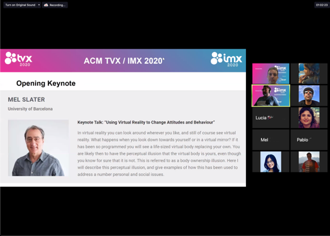
Sergi Fernandez introduced the opening keynote: Mel Slater (University of Barcelona) who talked about using Virtual Reality to Change Attitudes and Behaviour. Mel was my doctoral supervisor back in between 2001 and 2006 when I did a PhD at UCL. He was the reason I decided to focus my postgraduate studies to build expressive virtual characters. It was fantastic to “go to a conference with him” again even if he got the seat with the better weather. His opening keynote was engaging, entertaining and gave a lot of food for thought. He also had a new video of his virtual self being a rock star. To this day, I believe this is the main reason he got into VR in the first place! And why ever not?
Some of Mel Slater‘s opening keynote insights at IMX 2020 – 1.
Some of Mel Slater‘s opening keynote insights at IMX 2020 – 2.
Some of Mel Slater‘s opening keynote insights at IMX 2020 – 3.
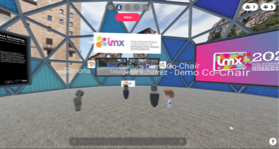
Immediately after Mels’ talk and Q&A session, it was time to inform attendees about the demos and posters available for viewing as part of the conference. The demos and posters were displayed in a series of Mozilla Hubs rooms (domes) created by Jesús Gutierrez (Universidad Politecnica de Madrid, Demo co-chair) and I, based off some models given to us by Liv (Mozilla). We were able to personalise the virtual spaces and give it a Spanish twist using a couple of panorama images David A. Shamma (FXPAL & Technical Program co-chair for IMX 2020) found on Flickr. Ayman and Julie Williamson (Univ. of Glasgow) also enabled the infrastructure behind the IMX Hub spaces. Jesús and I gave a short ‘how-to’ presentation to let attendees know what to expect in the IMX Hub Spaces. After our presentation, Mario played a video of pitches giving us quick lightning summaries of the demos, work-in-progress poster presentations and doctoral consortium poster displays.
The Poster on Mozilla Hubs in virtual Barcelona for IMX 2020 – 1.
The Poster on Mozilla Hubs in virtual Barcelona for IMX 2020 – 2.
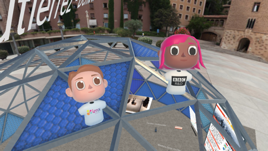
The Demo Domes on Mozilla Hubs in virtual Barcelona for IMX 2020.
I managed to persuade Jesús to take a selfie.
Thirty minutes later, it was time for the first paper session of the day (and the conference)! Ayman chaired the first four papers in the conference in a session titled ‘Augmented TV’. The first paper presented was one I co-authored with Radu-Daniel Vatavu (Univ. Stefan cel Mare of Suceava), Pejman Saeghe (Univ. of Manchester), Teresa Chambel (Univ. of Lisbon), and Marian F Ursu (Univ. of York). The paper (‘Conceptualising Augmented Reality Television for the Living Room’) examined the characteristics of Augmented Reality Television (ARTV) by analysing commonly accepted views on augmented and mixed reality systems, by looking at previous work, by looking at tangential fields (ambient media, interactive TV, 3D TV etc.) and by proposing a conceptual framework for ARTV – the “Augmented Reality Television Continuum”. The presentation is on the ACM SIGCHI’s YouTube channel if you feel like watching Pejman talk about the paper instead of reading it or maybe in addition to reading it!
Ayman and Pejman talking about our paper ‘Conceptualising Augmented Reality Television for the Living Room
I did not present the paper, but I was still relieved that it was done! I have noticed that once a paper I was involved with is done, I tend to have enough headspace to engage and ask questions of other authors. So that’s what I was able to do for the rest of the conference. In that same first paper session, Simon von der Au (IRT) et al. presented ‘The SpaceStation App: Design and Evaluation of an AR Application for Educational Television’ in which they got to work with models and videos of the International Space Station! Now, I love natural history documentaries so when I need to work with content, I don’t think I can go wrong if I choose David Attenborough narrated content – think Blue Planet. However, the ISS is a close second! They also cited two of my co-authored papers – Ziegler et al. 2018 and Saeghe et al. 2019 – which is always lovely to see.
Simon von der Au et al.’s paper on using AR for educational TV – 1.
Simon von der Au et al.’s paper on using AR for educational TV – 2.
Simon von der Au et al.’s paper on using AR for educational TV – 3.
My reaction to Simon von der Au et al.’s paper on using AR for educational TV.
After the first session, we had a 30-minute break before making our way to the Hubs Domes to look at demos and posters. Our outstanding student volunteers were deployed to guide IMX attendees to various domes. It was very satisfying seeing all our Hubs space populated with demos/posters with snippets of conversation flowing past as I passed through the domes to see how folks fared in the space. The whole experience resulted in a lot of selfies and images!
Selfies Galore and a few “candid” shots of others!!!
There were moments of delight throughout the event. I thought I’d rebel against my mom and get pink hair! Pablo got purple hair and IRL he does not have hair that colour (or that uniformly distributed). Ayman and I tried getting some virtual drinks – I got myself a pina colada while Ayman stayed sober. I also visited all the posters and demos which seldom happens when I attend conferences IRL. In Hubs, it was an excellent way to ‘bump into’ folks. I have been in the IMX community for a while, so I was able to recognise many people by reading their floating name labels. Most of their avatars looked nothing like the people I knew! Christian and Omar Niamut (TNO) had more photorealistic avatars but even those were only recognisable if I squinted! I was also very jealous of Omar’s (and Julie’s) virtual hands which they got because they visited the domes using their VR headsets. It was loads of fun seeing how people represented themselves through their virtual clothes, hair and body choice.
All of the demos and posters were well presented but the ‘Watching Together but Apart’ caught my eye because I knew my colleagues Rajiv Ramdhany, Libby Miller, and Kristian Hentschel built ‘BBC Together’ – an experimental BBC R&D prototype to enable people to watch and listen to BBC programmes together while they are physically apart. It was a response to the situation brought to a lot of our doorsteps by the pandemic! It was amazing to see that another research group responded in the same way to build a similar application. It was great fun talking to Jannik Munk Bryld about their project and compare notes.
“Sifter: A Hybrid Workflow for Theme-based Video Curation at Scale” from Univ. of Michigan and Snap Inc.
Once the paper session was over, there was a 45 minutes break to stretch our legs and rest our eyes. Longer in-between session breaks are a necessity in virtual conferences. At 2:30 PM (BST), it was time to listen to two industry talks chaired by Steve Schirra (YouTube) and Mikel Zorrilla (Vicomtech). Mike Darnell (Samsung Electronics America) talked of conclusions he drew from a survey study of hundreds of participants which focused on user behaviour when it came to choosing what to watch on the TV. The main take-home message was that people generally knew in advance exactly what they want to watch on TV.
Industry talk from Samsung – 1.
Industry talk from Samsung – 2.
Industry talk from Samsung – 3.
Industry talk from Samsung – 4.
Natàlia Herèdia (Media UX Design) talked of her pop-up media lab focusing on designing an OTT for a local public channel. She spoke of the process she used and gave a summary of her work on reaching new audiences.
Industry talk from Media UX Design, MediaLab Betevé – 1.
Industry talk from Media UX Design, MediaLab Betevé – 2.
Industry talk from Media UX Design, MediaLab Betevé – 3.
After the industry talk, it was time for a half an hour break. The organising committee and student volunteers went out to the demo domes in Hubs to get a group selfie! We realised that Ayman has serious ambitions when it comes to cinematography. After we got our shots, we attended another paper session chaired by Aisling Kelliher (Virginia Tech) titled ‘Live Production and Audience’. Other people might have mosquitos or mice as a pest problem. In this paper session, I learnt that there are people like Aisling whose pest problems are a little more significant – like bear sized bigger! So many revelations in such a short time!
The first paper of the last session, titled ‘DAX: Data-Driven Audience Experiences in Esports’, was presented by Athanasios Vasileios Kokkinakis (Univ. of York). He gave a fascinating insight into how companion screen applications might allow audiences to consume interesting data-driven insights during and around the broadcasts of Esports. It was great to see this wort of work since I have some history of working on companion screen applications with sports being one of the genres that could benefit from multi-device applications. The paper won the best paper award! Yvette Wohn (New Jersey Institute of Technology) presented a paper, titled ‘Audience Management practices of Live Streamers on Twitch’, in which she interviewed Twitch streamers to understand how streamers discover audience composition and use appropriate mechanisms to interact with them. The last paper of the conference was presented by Marian – ‘Authoring Interactive Fictional Stories in Object-Based Media (OBM)’. The paper referred to quite a few BBC R&D OBM projects. Again, it was quite lovely to see some reaffirmation of ideas with similar thought processes flowing through the screen.
Memories of the last paper session at IMX 2020 – 1.
Memories of the last paper session at IMX 2020 – 2.
Memories of the last paper session at IMX 2020 – 3.
My last question of the conference.
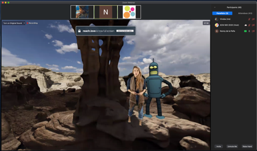
At 6 PM (BST), I had the honour of chairing the closing keynote by Nonny. Nonny had a lot of unique immersive journalism pieces to show us! She also gave us a live demo of her XR creation, remixing and sharing platform – REACH.love. She imported a virtual character inspired by the Futurama animated character – Bender. Incidentally, my very first virtual character was also created in Bender’s image. I had to remove the antenna off his head because Anthony Steed, who was my project lead at the time, wasn’t as appreciative of my character design – tragic times.
Nonny de la Peña’s closing keynote at IMX 2020 – 1.
Nonny de la Peña’s closing keynote at IMX 2020 – 2.
Nonny de la Peña’s closing keynote at IMX 2020 – 3.
Nonny de la Peña’s closing keynote at IMX 2020 – 4.
Alas, we had come near the end of the conference which meant it was time for Mario to give a summary of numbers to indicate how many attendees participated in IMX 2020 – spoiler: it was the highest attendance yet. He also handed out various awards. It turns out that our co-authored paper on ‘Conceptualising Augmented Reality Television for the Living Room’ got an honourable mention! More importantly, I was awarded the best social media reporter which is of course why you are reading this report! I guess this is an encouragement to keep on tweeting about IMX!
IMX 2020 numbers.
The organising committee who worked hard to virtualise the conference at such short notice.
Extra kudos – every conference should give extra kudos!
Awards collected at IMX 2020 – 1!
Awards collected at IMX 2020 – 2!
Frank Bentley (Verizon Media, IMX Steering Committee president) gave a short presentation in which he acknowledged that it was June the 19th – Juneteenth (Freedom Day) in the US. He gave a couple of poignant suggestions on how we might consider marking the day. He also talked about the rebranding exercise that resulted in the conference going from TVX to IMX.
Presentation from Frank Bentley (IMX Steering Committee President) – Juneteeth!
IMX rebrand and call for IMX 2022 bids!
Frank also announced that we are looking for host bids for IMX 2022! As VP of Conferences, I would be very excited to hear from you! Please do email me if you are looking for information about hosting an IMX conference in 2022 or beyond. You can also drop me a tweet @What2DoNext!
He then handed over the floor to Yvette and me to announce the proposed venue of IMX 2021 – New York! A few of the organising committee positions are still up for grabs. Do consider joining our exciting and diverse organising committee if you feel like you could contribute to making IMX 2021 a success! In the meantime, I managed to persuade my lovely colleague at BBC R&D (Vicky Barlow) to make a teaser video to introduce IMX 2021.
That brought us to the end of IMX 2020, sadly. The stragglers of the IMX community lingered a little to have a little bit of chat over zoom which was lovely.
Group Snaps at IMX 2020!
After the conference…
You would think that once the conference was over, that was it but no, not so. In years past, all that was left to do was to stalk people you met at the conference on LinkedIn to make sure the ‘virtual business cards’ were saved. Of course, I did a bit of that this year as well. However, this year had been a much more involved experience. I have had a chance to define the role of Diversity chairs with Asreen. I have had the chance to work with Ayman, Julie, Jesús, Liv and Blair to bring demos and posters to Hubs as part of the IMX 2020 virtual experience. It was a blast! You might have thought that I would be taking a rest! You would be wrong!
I am joining forces with Yvette and the rest of a whole new committee to start organising IMX 2021 – New York into a format that continues the success of IMX 2020 and strive to improve on it. Finally, let’s not forget Frank’s reminder that we are looking for colleagues out there (maybe you?) to host IMX 2022 and beyond!