


Authors: Xiongkuo Min (Shanghai Jiao Tong University, China), Guangtao Zhai (Shanghai Jiao Tong University, China), Patrick Le Callet (University of Nantes, France), Weisi Lin (Nanyang Technological University, Singapore)
Editors: Tobias Hoßfeld (University of Würzburg, Germany), Christian Timmerer (Alpen-Adria-Universität Klagenfurt and Bitmovin Inc., Austria)
Generative AI Opens New Possibilities for QoE
Quality of Experience (QoE) has long been a central topic in multimedia research, providing a human-centered perspective on content quality, system performance, and user perception [Möller 2014]. Through subjective assessment, predictive modeling, and QoE-aware optimization, researchers have developed approaches to improving multimedia services under diverse network and resource constraints.
The rapid advancement of generative AI is changing how multimedia content is created, delivered, and experienced. Unlike conventional multimedia services, where content is typically prepared for users, generative AI enables content to be created, edited, and adapted in response to user needs. Through natural language instructions and iterative feedback, users can continuously refine their requests, bringing content creation, interaction, and consumption closer together. Meanwhile, content generation, model inference, user interaction, and delivery are becoming increasingly interconnected, expanding the opportunities for QoE assessment and optimization.
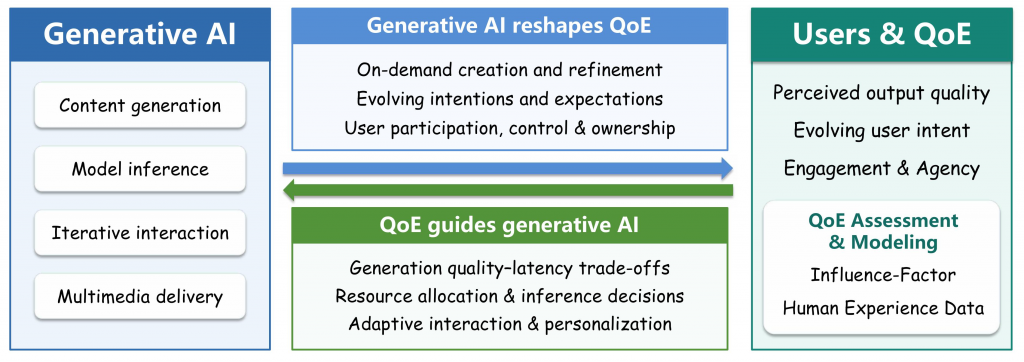
These developments raise new questions about how multimedia experiences are formed, how they can be assessed and modeled, and how QoE can guide generative AI systems toward better user experiences. This column explores these directions, as illustrated in Fig. 1, and discusses their implications for the future of multimedia services.
How Generative AI is Transforming QoE
In traditional multimedia services, QoE primarily reflects users’ perceptions of delivered content and service quality [Möller 2014]. Advances in generative AI have enabled users to actively participate in content creation and refinement. Through natural language instructions and iterative feedback, users can shape generated content and build upon previous results, increasingly intertwining content quality with interaction experience. This shift gives users a greater role in shaping their own multimedia experiences.
Evolving User Intent and Expectations
Interactions with generative AI may lead to changes in users’ intentions and expectations. Initial generated results may inspire new ideas, encourage further exploration, or prompt users to reconsider their original goals. Subsequent interactions may further reshape both the generated content and users’ perceptions of the experience, creating a dynamic relationship among user intentions, system behavior, and perceived quality. Understanding this evolving relationship presents an important direction for QoE research in the age of generative AI.
Beyond Output Quality: User Engagement and Agency
In interactive generative AI applications, users’ experiences may depend on factors beyond output quality, such as their ability to express intentions, maintain control, explore alternatives, and develop a sense of ownership over the resulting content [Amershi 2019, Shneiderman 2020]. For example, a recent study found that model-led collaboration improved creative output quality but reduced idea diversity and users’ perceived ownership, while human-led approaches achieved a better balance among these aspects [Maier 2026]. Together, these developments suggest an evolving perspective on multimedia QoE, in which generated content, user participation, and interactive processes jointly contribute to the overall experience.
Rethinking QoE Assessment and Modeling
Perceptual quality assessment of AI-generated content has attracted growing research attention [Wang 2025]. The dynamic and interactive nature of generative AI experiences introduces new challenges, calling for new approaches to understanding and modeling QoE [Zhou 2026].
QoE Modeling based on Influence Factors
One promising approach is to identify key influence factors and investigate their relationships with QoE, building on established methodologies in traditional QoE research. These factors may include perceptual quality, semantic consistency, generation speed, response latency, and interaction characteristics. Controlled subjective experiments can help examine their effects and develop interpretable QoE models. Existing studies have explored QoE modeling for interactive LLM services using such approaches [Hupont 2026, Schlechte 2025]. However, the relevant factors and their relationships may vary considerably across different generative AI tasks and contexts, making such models difficult to generalize.
QoE Modeling from Human Experience Data
Advances in foundation models offer another approach to QoE modeling by learning directly from human experience data. Such data may include multimodal content, interaction histories, user feedback, and contextual information, which could be used to train AI-based QoE predictors that approximate human QoE judgments. However, since QoE fundamentally concerns human experience, continuous validation against real human feedback is essential to prevent the evaluation objective from shifting toward model preferences.
How QoE can Guide Generative AI Systems
QoE has long guided multimedia service optimization, including adaptive streaming and resource allocation, to balance perceived quality and system constraints [Seufert 2014]. Generative AI further expands this optimization space by allowing QoE to influence content generation itself, alongside inference, interaction, and delivery. With reliable QoE models, generative AI systems could make decisions based on anticipated user experience, such as balancing generation quality against response time, allocating resources according to user needs, or adapting interaction strategies to different tasks. Recent studies have explored using human-aligned quality assessments as reward signals to improve generative video models [Wang 2025 (LOVE)], suggesting the potential for extending such approaches toward broader QoE-driven optimization. Looking ahead, QoE could become an integral part of generative AI systems, guiding how content is created, refined, and delivered in response to user expectations. This would open opportunities for connecting human experience with generative model development and intelligent service optimization.
Outlook and Takeaways
The rapid development of generative AI is opening new directions for QoE research. Generative AI is reshaping how users create and experience multimedia content, calling for new approaches to understanding and modeling dynamic user experiences. Meanwhile, QoE offers a human-centered perspective to guide content generation, interaction, and system optimization. Looking ahead, QoE-in-the-loop generative multimedia represents a promising direction for enabling more adaptive, personalized, and experience-driven services.
This vision aligns closely with the discussions envisioned for QoMEX’27, which will explore the evolving landscape of quality of multimedia experience in the age of generative AI. As generative technologies reshape how multimedia is created, delivered, and experienced, the conference invites the research community to explore emerging challenges and opportunities in QoE assessment, modeling, and optimization, and to advance more human-centered multimedia systems.
These directions reflect the expanding scope of QoE research and reaffirm QoMEX as an important forum for exchanging ideas and advancing multimedia experience research. The 19th International Conference on Quality of Multimedia Experience (QoMEX’27) will take place in Shanghai, China, from July 6 to 9, 2027. More information is available at https://qomex2027.itec.aau.at/.
References
- [Möller 2014] Sebastian Möller and Alexander Raake. 2014. Quality of experience. Springer.
- [Amershi 2019] Saleema Amershi, Dan Weld, Mihaela Vorvoreanu, Adam Fourney, Besmira Nushi, Penny Collisson, Jina Suh, Shamsi Iqbal, Paul N. Bennett, Kori Inkpen, Jaime Teevan, Ruth Kikin-Gil, and Eric Horvitz. 2019. Guidelines for Human-AI Interaction. In Proceedings of the 2019 CHI Conference on Human Factors in Computing Systems (CHI ’19). Association for Computing Machinery, New York, NY, USA, Paper 3, 1–13. https://doi.org/10.1145/3290605.3300233
- [Shneiderman 2020] Shneiderman, B. 2020. Human-Centered Artificial Intelligence: Reliable, Safe & Trustworthy. International Journal of Human–Computer Interaction, 36(6), 495–504. https://doi.org/10.1080/10447318.2020.1741118
- [Maier 2026] Sebastian Maier, Manuel Schneider, and Stefan Feuerriegel. 2026. Partnering with Generative AI: Experimental Evaluation of Model-Led and Human-Led Interaction in Human-AI Co-Creation. In Proceedings of the 2026 CHI Conference on Human Factors in Computing Systems (CHI ’26). Association for Computing Machinery, New York, NY, USA, Article 1260, 1–28. https://doi.org/10.1145/3772318.3791185
- [Wang 2025] Jiarui Wang, Huiyu Duan, Guangtao Zhai, Juntong Wang, and Xiongkuo Min. 2025. AIGV-ASSESSOR: Benchmarking and Evaluating the Perceptual Quality of Text-to-Video Generation with LMM. In 2025 IEEE/CVF conference on computer vision and pattern recognition (CVPR). IEEE, 18869–18880. https://doi.org/10.1109/CVPR52734.2025.01758
- [Zhou 2026] Wei Zhou, Hadi Amirpour, Tobias Hoßfeld, and Christian Timmerer. 2026. Quality of Multimedia Experience Meets Machine Intelligence. SIGMultimedia Rec. 18, 1, Article 3 (January 2026), 1 pages. https://doi.org/10.1145/3811013.3811016
- [Hupont 2026] Isabelle Hupont, Katrien De Moor, Lea Skorin-Kapov, Martin Varela, Tobias Hoßfeld, and Christian Timmerer. 2026. Rethinking QoE in the Age of AI: From Algorithms to Experience-Based Evaluation. SIGMultimedia Rec. 17, 4, Article 3 (October 2025), 1 pages. https://doi.org/10.1145/3811005.3811008
- [Schlechte 2025] Florian Schlechte, Yusra Tasnim Farooqi, and Matthias Hirth. 2025. Assessing the Influence of End-to-End Request Latency and Response Length on Waiting Time Satisfaction of LLM Users. In 2025 17th International Conference on Quality of Multimedia Experience (QoMEX). IEEE, 1–4. https://doi.org/10.1109/QoMEX65720.2025.11219949
- [Seufert 2014] Michael Seufert, Sebastian Egger, Martin Slanina, Thomas Zinner, Tobias Hoßfeld, and Phuoc Tran-Gia. 2014. A Survey on Quality of Experience of HTTP Adaptive Streaming. IEEE Communications Surveys & Tutorials 17, 1 (2014), 469–492. https://doi.org/10.1109/COMST.2014.2360940
- [Wang 2025 (LOVE)] Jiarui Wang, Huiyu Duan, Ziheng Jia, Yu Zhao, Woo Yi Yang, Zicheng Zhang, Zijian Chen, Juntong Wang, Yuke Xing, Guangtao Zhai, et al. 2025. LOVE: Benchmarking and Evaluating Text-to-Video Generation and Video-to-Text Interpretation. arXiv preprint arXiv:2505.12098 (2025). https://doi.org/10.48550/arXiv.2505.12098